The Hidden Cost of Financial Stress at Work
Written by: Clinton Graham
|
CFA, CFP
Published: Apr 06, 2026

Financial stress doesn’t just affect your employees. It affects your bottom line. The cost is real. And in most companies, it’s invisible.
Financial stress is often viewed as a personal issue. Something employees deal with outside of work. In reality, it shows up every day inside the workplace. Employees don’t leave financial concerns at home. They bring them into meetings, into decisions, and into their day-to-day focus. Even small distractions, repeated across a team, can create a meaningful impact. What’s often missed is that this impact can be measured. Let’s look at a simple example. A company with 100 employees, each earning an average of $100,000 per year. Research shows that 43% of employees admit to being financially distracted at work. Of those, a portion spend several hours each week dealing with financial issues during working hours. If we apply those assumptions: • 43 employees are financially distracted • About half of those spend 3.5 or more hours per week dealing with financial issues • The other half spend smaller amounts of time Across the company, this can add up to over 4,000 hours per year spent on personal financial matters during work hours. When translated into compensation, that’s over $200,000 annually in lost productivity. And this is a conservative estimate. This isn’t a small issue either. At a national level, financial stress is estimated to cost Canadian businesses approximately $69.5 billion annually in lost productivity. It doesn’t account for reduced focus during the rest of the workday, decision fatigue, or the broader impact on team performance.
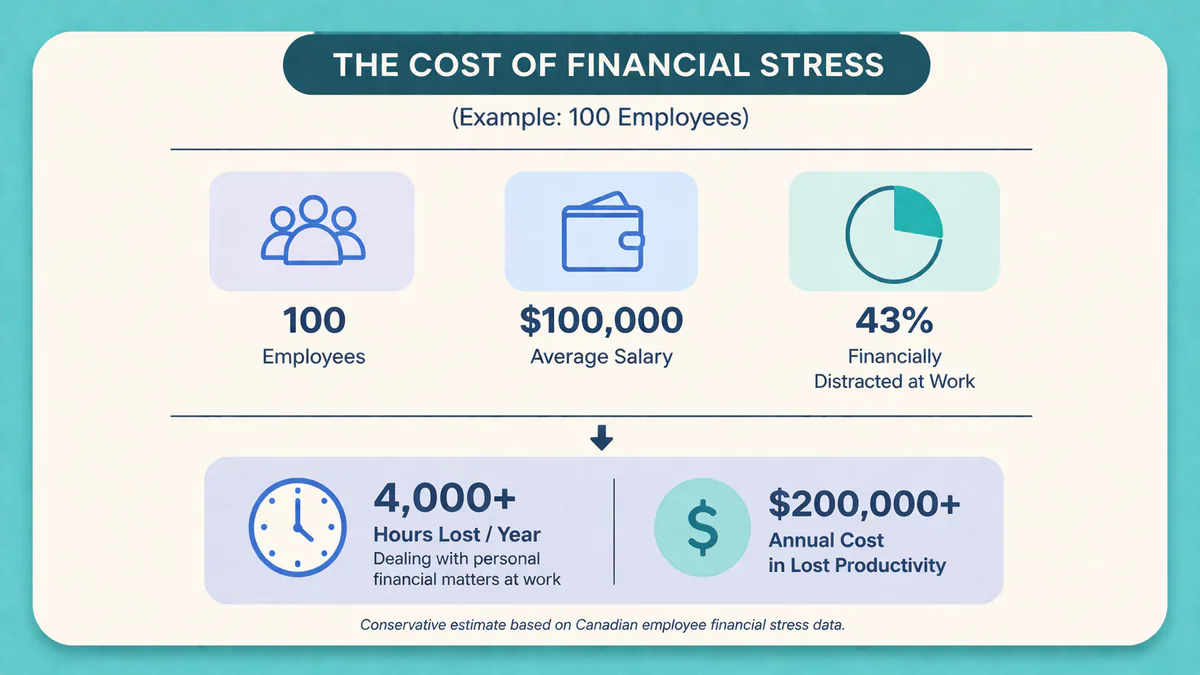
What gets measured gets managed. Financial stress is measurable.
It also doesn’t capture the effect on retention. Employees experiencing financial stress are more likely to seek higher-paying opportunities, even if the increase is marginal. Without clarity or confidence in their financial situation, compensation becomes the primary solution they see. From a business perspective, this creates two challenges: • Lost productivity today • Increased turnover risk over time Both are difficult to track directly, but both are real. This is where financial wellness becomes more than a benefit. It becomes a business tool. Providing employees with access to financial guidance doesn’t eliminate financial stress entirely, but it reduces uncertainty. It helps employees understand where they stand, what to do next, and how to move forward. That clarity has a ripple effect. Employees who feel more in control of their finances tend to be more focused, more engaged, and more likely to stay. The goal isn’t to solve every financial problem. It’s to reduce the friction that’s quietly impacting performance.
Written by Clinton Graham, CFA, CFP
Clinton Graham is the founder of JayPlans and brings over a decade of experience in financial planning and investment management.
Reviewed for financial planning accuracy by the JayPlans planning team.